
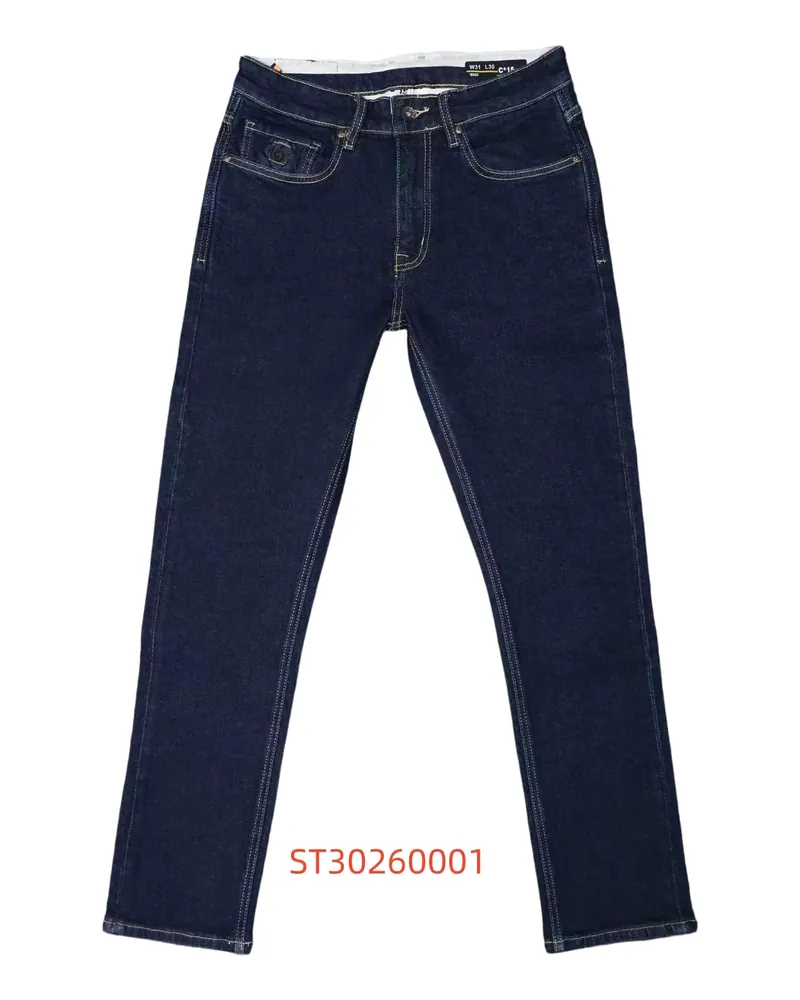
Every week someone at the counter holds up two pairs of C-15s, one stiff, dark and almost plasticky to the touch, one soft and pre-faded, and asks why the stiff one costs more. It's the best question in denim. The answer runs through how jeans are actually made, what "raw" and "washed" mean, and which of the two suits your life. Five minutes here saves you two years with the wrong pair.
What raw denim is
All denim starts the same way: cotton yarn is dyed in indigo, a dye that famously coats the outside of the fibre rather than penetrating it, then woven, cut and sewn. Raw (or "dry") denim is simply that fabric sold as-is, never washed after weaving. It arrives stiff with starch and loom finish, uniformly deep in colour, and heavy in the hand: our Raw Indigo Slim is a 14 oz example, near the top of what daily wear wants.
Because the indigo sits on the yarn's surface, raw denim records everything: where your phone lives, how you sit, what you carry. Over months the high-friction points shed dye and lighten, whiskers at the hips, honeycombs behind the knees, a wallet ghost on the seat, producing a fade map of your specific life. That personalisation is the entire romance of raw denim, and the reason enthusiasts treat the first months as an investment period.
What washed denim is
Washed denim has been finished at the factory: laundered, softened, and usually faded on purpose, stone-washed with abrasive pumice, enzyme-washed for softness, or hand-finished for whiskers and wear patterns. The jean arrives comfortable on day one, its colour and character decided by the factory rather than by you. Most jeans sold worldwide are washed; our Stone Wash Taper and Vintage Blue Relaxed are honest examples of the craft.
The real trade-offs, without romance
Comfort timeline
Washed: comfortable in the changing room. Raw: two to six weeks of stiffness before the fabric surrenders, and the first few wears can feel like breaking in boots. If that sentence made you tired, buy washed, there is no prize for suffering.
Colour behaviour
Washed denim holds roughly the colour you bought, fading slowly and evenly. Raw denim changes constantly, deep and formal for the first months (raw's dark uniform actually reads dressier in offices), then increasingly personal. Crucially, raw crocking is real: a new raw jean can transfer blue onto light sneakers and cafe chairs for the first weeks. White-sofa owners, be warned.
Durability and weight
Weight, not rawness, drives durability, but raw jeans are usually offered in heavier fabrics (13–15 oz) than mainstream washed jeans (11–13 oz), and factory abrasion does spend a little of a washed jean's life before you buy it. A heavy raw pair, cared for properly, is the longest-lived jean money buys; a quality washed pair is close behind and asks far less of you.
Care burden
Washed denim forgives normal laundry habits (within the care rules). Raw denim demands doctrine: months before the first wash, cold-water baptism, shade drying. The doctrine is the hobby; if it sounds like homework instead, that's your answer.
Which one is for you
- Choose raw if: you wear jeans near-daily (fades need mileage), enjoy things that improve with effort, want the darkest possible jean for office double-duty, and can follow the care rules. Denim-as-hobby people, this is your door.
- Choose washed if: you want comfort today, rotate several pairs, wash on a normal schedule, or specifically want the lived-in light and mid washes that raw takes years to reach. Denim-as-clothing people, most people, belong here, happily.
- Own both if: the wardrobe allows. A raw pair ageing slowly in the background while washed pairs handle the daily grind is the enthusiast's steady state, and the two-jean capsule slot accommodates exactly this split.
Reading a jean's honesty in the shop
Whichever side you choose, the same sixty-second inspection applies at any counter, ours included. Turn the jean inside out: seam edges should be finished, not fraying. Tug the side seam gently: dense, even stitching is the tell of a garment built to be repaired rather than replaced. Check the hardware: rivets and zips should feel like metal decisions, not afterthoughts. Look at the wash under daylight, not showroom bulbs, uneven blotching that isn't deliberate fading is a factory shortcut. Raw hides flaws less than washed, which is one more reason its buyers tend to become inspectors; bring the habit to every denim purchase and the habit pays for itself annually.
Understanding weight classes
Denim weight, ounces per square yard, is the spec that quietly decides comfort, and it applies to raw and washed alike. Under 12 oz is summer denim: light, breathable, quick to dry, quicker to wear out. The 12.5–13.5 oz band is the all-year sweet spot for Nepal, which is why most of the C-15 line lives there: substantial enough for winter wind on a bike, tolerable in a May afternoon. At 14 oz and above you're in enthusiast territory, durable, wind-proof, magnificent in January, and honest work in June. Match the weight to your months: a Kathmandu man served by one jean picks 13.5 oz; a man running two picks one light and one heavy, and the rotation covers the calendar.
A note on selvedge, since you'll ask
Selvedge refers to fabric woven on old-style shuttle looms whose self-finished edge shows as the tidy coloured stripe inside the cuff. It overlaps with raw denim culture but is a separate axis: selvedge can be washed, raw can be non-selvedge. The stripe signals a slower weave and denim-nerd credentials; it does not by itself make a better jean than a well-made wide-loom fabric. Buy the fabric and fit, not the cuff flash, advice that costs us nothing and saves you plenty.
The counter verdict
Raw is a relationship; washed is a good friend. Both, done well, outlast fast-fashion denim by years, the deciding question is honestly how much attention you want your trousers to require. Come squeeze both at Shop B2; hands decide this faster than words.
References & further reading
- Denim, production and washes (Wikipedia)
- Selvage (Wikipedia)
- Indigo dye (Wikipedia)
- Stone washing (Wikipedia)
Come try it in person. Everything in this guide is on the rail at Shop B2, Ranjana Mall, New Road, Kathmandu, open daily 10:00 AM – 7:00 PM. Directions and contact.